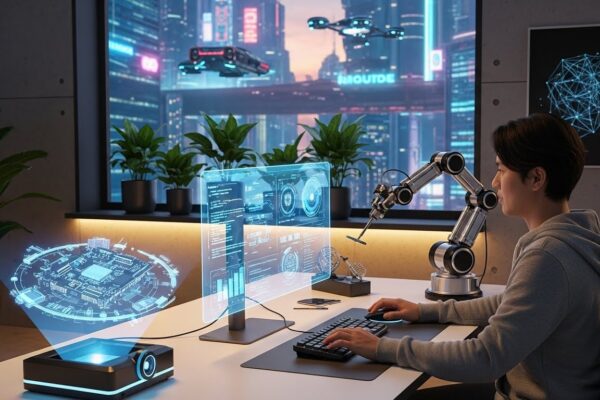
Human-computer interaction, often referred to as HCI, has evolved rapidly since the earliest days of computing. What started with simple punch cards and command lines has developed into touchscreens, voice commands, gesture recognition, and immersive technologies like virtual and augmented reality. Each advancement has brought computers closer to people, breaking down barriers and making digital technology more accessible and intuitive. As we look to the future, the relationship between humans and computers will continue to transform in profound ways, fundamentally reshaping how we work, learn, communicate, and live.
The Evolution of Human-Computer Interaction
To understand where HCI is going, it is useful to examine where it has been. In the earliest stages of computing, interaction was limited to text-based commands, which required users to have specialized knowledge. The introduction of the graphical user interface in the 1980s changed everything, as computers became accessible to non-technical users through windows, icons, and menus. The mouse and later the touchscreen opened new possibilities by enabling intuitive control.
The 2000s brought voice assistants and smartphones, making computing not only portable but conversational. Today, we interact with devices through touch, speech, vision, and even wearables that sense our movements and biometrics. Each phase of HCI has sought to reduce friction, bringing us closer to a future where technology feels natural, seamless, and almost invisible.
The Rise of Natural User Interfaces
The future of HCI is moving toward natural user interfaces, often referred to as NUIs. These interfaces rely on human instincts rather than requiring users to learn new methods of control. For example, instead of typing on a keyboard, we can speak commands; instead of clicking a mouse, we can gesture in the air. Technologies like Microsoft’s Kinect and modern VR headsets have already given us glimpses of this shift.
Future NUIs will likely integrate multiple modes of input simultaneously, allowing people to talk, gesture, and move naturally while interacting with digital systems. Imagine giving a presentation where slides advance with a hand gesture while your voice triggers embedded videos and your facial expressions adjust lighting or emphasis. Such multi-sensory interactions will redefine productivity, entertainment, and everyday life.
Voice and Conversational Interfaces
Voice-based interaction has grown significantly in recent years, with virtual assistants like Siri, Alexa, and Google Assistant becoming commonplace. However, current systems are still limited, often requiring specific commands and struggling with contextual understanding. The future of conversational AI will be far more advanced.
Next-generation voice interfaces will understand not only words but also tone, intent, and emotional state. They will engage in natural, human-like conversations that go beyond simple queries. For instance, instead of asking a virtual assistant to set a timer, you could explain that you are baking bread, and the system would automatically recommend optimal settings, track progress, and provide step-by-step reminders.
Voice interfaces will expand into workplaces, healthcare, and education, making information accessible to those who may struggle with traditional interfaces. For individuals with disabilities, this evolution will be especially transformative, providing independence and empowerment.
Gesture and Motion Recognition
Gesture recognition will play a vital role in future HCI. Already, some devices can track hand and body movements to control games or navigate interfaces. As sensors become more accurate and widespread, gestures will become an everyday form of input.
In the future, we may control computers by waving a hand in mid-air, designing 3D objects by sculpting them virtually, or navigating data by physically moving through visualizations. The convergence of gesture recognition with augmented reality will create opportunities for professionals in design, engineering, and medicine to manipulate digital content in ways that feel physically real. Gesture-based interaction will eliminate the need for physical keyboards or controllers in many contexts, making computing more immersive.
Eye-Tracking and Gaze-Based Interaction
Another area of rapid development is eye-tracking technology. Computers are becoming capable of detecting where users are looking, enabling gaze-based navigation and control. This technology has powerful implications for accessibility, allowing individuals with mobility challenges to control devices simply by looking at the screen.
In the future, gaze-based systems may allow us to read articles without scrolling, as text follows our eyes automatically. Advertising and marketing may adapt in real time based on where people look, and gaming will become more immersive by integrating eye movement into gameplay. The potential of eye-tracking lies in its subtlety, offering hands-free and almost subconscious interaction.
Brain-Computer Interfaces
Perhaps the most futuristic area of HCI is brain-computer interfaces, or BCIs. These systems allow direct communication between the brain and a computer, bypassing traditional inputs altogether. While still in experimental stages, research has shown that it is possible to control cursors, robotic limbs, and even type words using only thought.
The implications of BCIs are extraordinary. For individuals with paralysis or other severe disabilities, they could provide new levels of independence. For the general population, BCIs may one day allow us to interact with computers at the speed of thought, radically improving productivity. Imagine composing an email, editing a video, or designing a model simply by thinking about it.
Of course, BCIs also raise questions about privacy, ethics, and the merging of human cognition with machine intelligence. As this field develops, society will need to carefully balance the benefits with the risks.
Augmented Reality as a Daily Interface
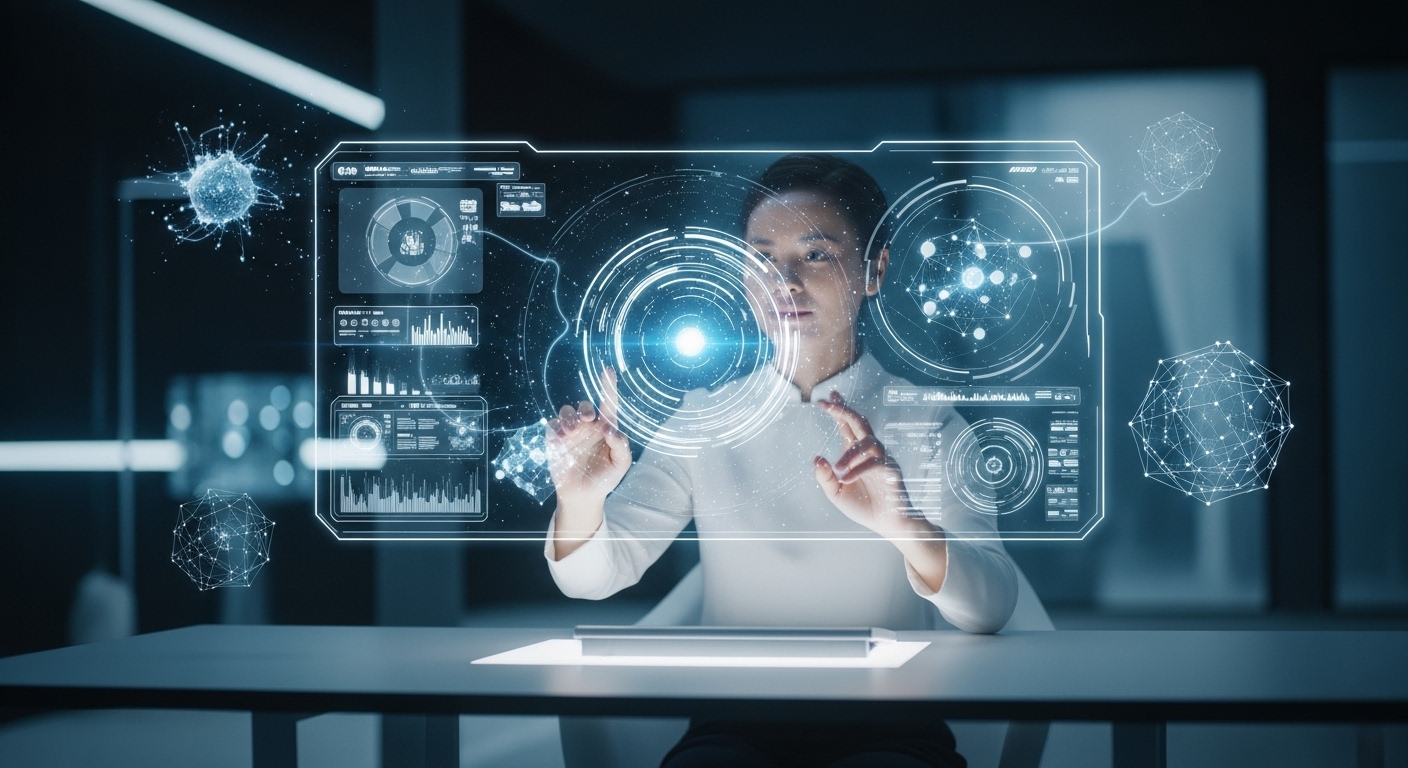
Augmented reality has already begun to transform industries like gaming, education, and design. By overlaying digital information on the physical world, AR creates a hybrid environment where interaction feels both natural and enhanced. Future AR glasses or contact lenses could provide constant access to digital tools without the need for traditional screens.
In workplaces, AR could project virtual dashboards directly into a user’s field of vision, replacing monitors. In healthcare, surgeons could see patient data and imagery in real time during operations. In education, students could explore interactive content layered onto their real-world surroundings. The future of AR lies in making computers invisible by embedding them seamlessly into our perception of reality.
Virtual Reality as an Immersive Workspace
Virtual reality, unlike AR, creates fully digital environments. While it is currently associated with gaming, VR has vast potential for productivity. Future offices may exist entirely in VR, where workers across the globe meet in virtual conference rooms and collaborate on shared projects.
In such environments, physical limitations vanish. Data can be visualized in three dimensions, training simulations can replicate real-world conditions, and social interaction can occur in lifelike avatars. VR could redefine the concept of remote work, offering presence and immersion that traditional video conferencing cannot match.
Emotional and Adaptive Interfaces
The future of HCI will not only respond to what we say or do but also how we feel. Emotion recognition technologies are advancing, enabling computers to detect facial expressions, voice inflections, and physiological signals to assess emotional states. Adaptive interfaces will adjust accordingly, offering encouragement when users feel frustrated or reducing distractions when focus is needed.
For example, an educational platform might slow down when it detects confusion or provide motivational feedback when it senses disengagement. In professional settings, adaptive systems could optimize workloads based on stress levels, ensuring healthier and more sustainable productivity. By becoming emotionally intelligent, computers will move closer to true partnership with humans.
The Role of Artificial Intelligence
Artificial intelligence will underpin much of the future of HCI. AI enables systems to learn from user behavior, anticipate needs, and personalize interactions. Instead of static interfaces, we will have adaptive systems that evolve with us. AI-driven assistants will not only respond to commands but also predict tasks, automate repetitive processes, and provide insights before we even ask.
This shift from reactive to proactive interaction will change the very nature of productivity. Computers will no longer be passive tools but active collaborators, working alongside humans to achieve goals more efficiently.
Ethical Considerations in Future HCI
As exciting as these technologies are, they also raise serious ethical questions. Privacy is a major concern, as systems that track gaze, emotions, or brain activity could collect deeply personal data. Ensuring that this information is protected will be critical to maintaining trust.
There is also the risk of over-reliance on technology. If interfaces become too seamless, humans may lose essential skills or become vulnerable to manipulation. Accessibility must also be a priority, ensuring that future HCI benefits everyone, not just those with resources to access advanced tools. The future of HCI will require balancing innovation with responsibility, ensuring that human dignity remains at the center.
The Future Workplace and HCI
The workplace of the future will be shaped by advanced HCI. Collaboration will occur across immersive platforms where distance no longer matters. Employees may interact with digital assistants that anticipate their needs, automatically schedule tasks, and filter out distractions. Training and onboarding may occur in VR, while AR enhances everyday tasks.
Such changes will redefine productivity, creativity, and teamwork. While automation will handle repetitive work, human workers will focus on problem-solving, innovation, and emotional intelligence. The synergy of advanced HCI and human creativity will drive new levels of efficiency and opportunity.
The Future Home and HCI
HCI will also transform personal lives. Smart homes will become more intelligent, with appliances, entertainment systems, and security controlled effortlessly through voice, gestures, or thought. Personalized assistants will anticipate household needs, from restocking supplies to optimizing energy usage.
In education, children may interact with immersive digital tutors, while entertainment will blend seamlessly between real and virtual worlds. For healthcare, HCI will enable continuous monitoring, personalized treatment, and accessible telemedicine. The home will become a space where technology works quietly in the background, enhancing comfort and convenience without demanding constant attention.
Conclusion
The future of human-computer interaction promises a world where technology feels natural, intuitive, and deeply integrated into daily life. From voice and gesture to brain-computer interfaces, from augmented reality to emotionally adaptive systems, HCI is moving toward a future where computers are not just tools but partners in human progress.
This transformation will bring both opportunities and challenges. It will empower individuals with greater accessibility, creativity, and productivity, but it will also require careful attention to privacy, ethics, and inclusivity. Ultimately, the future of HCI is not just about technology—it is about people. It is about creating systems that enhance human potential, respect human dignity, and shape a world where humans and computers thrive together.